




Interstitial Cystitis
Interstitial cystitis is a chronic condition of the bladder. Symptoms include pain, pressure, or discomfort associated with urinary frequency and/or urgency. Symptoms vary from mild to severe and from intermittent to constant. Interstitial cystitis can have a negative impact on both patients and those around them. Many cases are mild or moderate, but sometimes progress to very severe forms. In the past, interstitial cystitis was believed to be a rare disease that was very difficult to treat. Today, due to advances in diagnostic methods and patients’ expectations for a better quality of life, it has been determined that interstitial cystitis affects many people, both women and men.
This article aims to help you understand interstitial cystitis and the treatments available for it.
Under normal circumstances
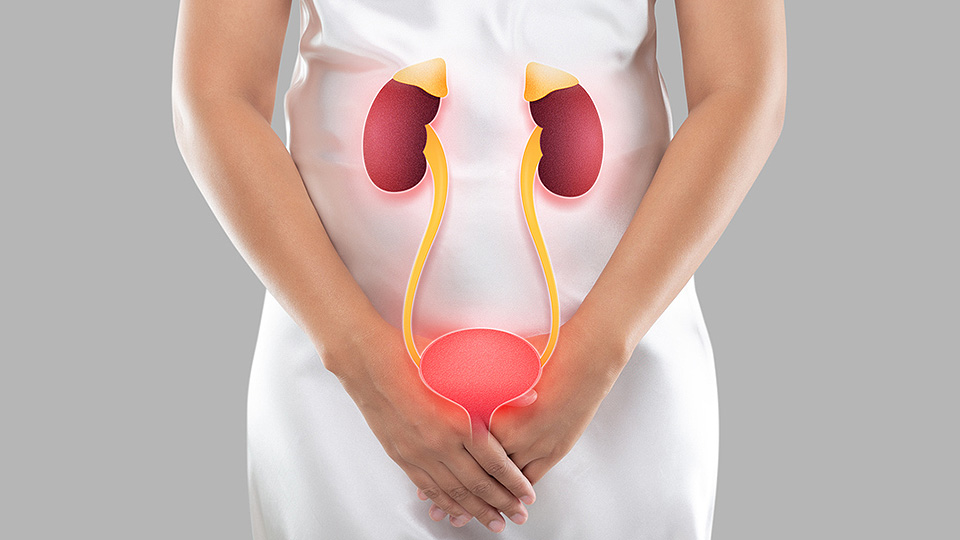
After urine is produced in the kidneys, it flows down the ureters into the bladder. The bladder is a hollow, balloon-like organ. Most of the bladder wall is made up of muscle. When the bladder fills, the muscle structures forming the bladder wall relax, allowing the bladder to expand and store urine for a certain period of time. To urinate, the bladder muscle contracts. The urethra is a tube through which urine passes from the bladder. The urethra has a sphincter muscle, which is completely different from the bladder muscle. The sphincter normally remains closed and provides insulation against urine leakage. When urinating, the sphincter opens and allows urine to pass. The bladder and urethra have a special lining called the epithelial layer. The epithelium forms a barrier between urine and the bladder muscle. The epithelial layer also helps prevent bacteria from adhering to the bladder. Thus, it protects against bladder infections.
What is interstitial cystitis?
Interstitial cystitis is a chronic bladder condition. Symptoms can be mild or severe, intermittent or constant. It is not an infection, but its symptoms can feel similar to those of a bladder infection. In women, it is often associated with pain during sexual intercourse. Interstitial cystitis is also called ‘Painful Bladder Syndrome’ and may be associated with irritable bowel syndrome, fibromyalgia, chronic fatigue syndrome, and other pain syndromes.
Risk factors for interstitial cystitis
There are no known specific behaviors (such as smoking) or external influences that increase the risk of interstitial cystitis. The tendency to develop interstitial cystitis is determined by a person’s genes and may be hereditary. Approximately 80% of people diagnosed with interstitial cystitis are women. This suggests that being female may increase the risk of developing interstitial cystitis. However, the difference in the incidence of interstitial cystitis between men and women may not be as high as previously thought. Some men diagnosed with “prostatitis” or other conditions may actually have interstitial cystitis.
Causes of interstitial cystitis
Research is being conducted at many centers to determine the causes of interstitial cystitis. Many researchers believe that one or more of the following may cause interstitial cystitis:
- Due to a defect in the bladder epithelial layer, irritants in the urine penetrate into the bladder;
- The presence of histamine-releasing inflammatory cells (mast cells) and other chemicals in the bladder that cause interstitial cystitis symptoms;
- The presence of substances in urine that damage the bladder;
- Normally painless events (such as bladder filling) causing pain due to changes in the nerves that carry bladder sensation;
- Damage to the bladder caused by the body’s immune system, similar to other autoimmune conditions.
Interstitial cystitis can manifest itself in different ways in different patient groups. It is possible that these different processes (e.g., a defect in the bladder epithelium, which can stimulate mast cells by promoting inflammation) influence each other. Recent studies suggest that there may be a substance in the urine of patients with interstitial cystitis that inhibits the growth of epithelial cells in the bladder. Some people may be predisposed to interstitial cystitis for reasons such as infection in the bladder following an injury.
Symptoms of interstitial cystitis
The symptoms of interstitial cystitis vary among patients. The most common symptoms are frequent urination, sudden urgency to urinate, and pain or pressure in the bladder or vagina. Often, discomfort may be caused by all of these symptoms.
Here, frequency refers to the need to urinate more often than normal. Normally, a person urinates no more than seven times a day on average and does not have to get up at night to use the toilet. Interstitial cystitis patients usually feel the need to urinate frequently both during the day and at night. As this frequency increases, it gradually leads to a sudden urge to urinate. Sudden urgency is a common symptom of interstitial cystitis. Some patients feel a constant urge to urinate that never goes away, even immediately after urinating. Others may not feel this urge as strongly.
As the bladders of interstitial cystitis patients fill up, bladder pain may worsen. Some interstitial cystitis patients feel pain in areas other than the bladder. Pain may be felt in the urethra, lower abdomen, back, pelvic, or perineal area. Women may feel pain in the vulva or vagina, and men may feel pain in the scrotum, testicles, or penis. Pain may be constant or intermittent.
Many interstitial cystitis patients can identify certain things that make their symptoms worse. For example, some people find that their symptoms worsen with certain foods or beverages. Many patients also report that their symptoms worsen when they are stressed (physically or mentally). Symptoms may vary with the menstrual cycle. Both men and women with interstitial cystitis may experience difficulties with sexual activity. Because the bladder is located directly in front of the vagina, women may experience pain during intercourse. Men may experience painful orgasms or pain the following day.
Diagnosis of interstitial cystitis
There are differing opinions regarding the diagnosis of interstitial cystitis. There is no single test that definitively confirms the diagnosis. The patient’s medical history, physical examination, and urine test results are important in ruling out other conditions that could cause the symptoms.
The most important test for diagnosis is cystoscopy. Cystoscopy is a test that can be performed under local or general anesthesia. For interstitial cystitis, it is appropriate to perform cystoscopy under anesthesia. The reason for this is that during the procedure, when fluid is instilled into the bladder, patients diagnosed with interstitial cystitis experience severe pain. Bladder capacity is lower when the patient is awake than when under anesthesia. Anesthesia is also necessary to objectively determine bladder capacity. Furthermore, during cystoscopy performed under anesthesia, it is possible to take a biopsy from the bladder mucosa and carry out an important step in diagnosing the disease.
Cystoscopy performed under local anesthesia usually yields normal results. Therefore, it is not considered a necessary test for diagnosing interstitial cystitis. Although cystoscopy performed under anesthesia is primarily used as a diagnostic test, many interstitial cystitis patients experience symptom relief after this procedure. This relief is thought to be due to an increase in bladder capacity to 500-600 ml under anesthesia.
Although urodynamic evaluation can be considered part of the evaluation of interstitial cystitis, most physicians do not believe it is necessary in every case. This test involves filling the bladder with water through a small catheter and then measuring the bladder pressure as the bladder fills and empties. In patients with interstitial cystitis, a low bladder capacity and painful filling are expected.
Another diagnostic test is the potassium sensitivity test. During this test, potassium solution and normal serum fluid are instilled separately into the bladder. The resulting pain and urgency scores are compared. A person with interstitial cystitis feels more pain and urgency with the potassium solution than with the water solution, but patients with normal bladders cannot tell the difference between the two solutions. Although this test is very valuable, it can be painful. Therefore, it is not definitively diagnostic for interstitial cystitis and is not a routine part of the evaluation. Currently, there is no definitive answer regarding the best approach for diagnosing interstitial cystitis. If a patient has typical symptoms and no infection or blood is found in urine tests, interstitial cystitis should be suspected.
Stages of interstitial cystitis
Interstitial cystitis is a disease that usually begins over a long period of time as a problem that the patient cannot fully describe, in the form of frequent urination. Rarely, it can come on rapidly and with much more dramatic symptoms within days, weeks, or months of onset. Symptoms become chronic within the first 12-18 months of the disease. After that, the disease may not progress further. In some patients, the disease can progress significantly, causing the bladder to shrink to a capacity where it can barely store urine.
How is it treated?
The exact cause of interstitial cystitis is unknown. Since there are several possible causes, no single treatment works the same for every patient. Treatment should be tailored to each individual based on their symptoms. The common approach is to try different treatments (or combinations of treatments) to minimize the patient’s complaints. Currently, there are two treatment options approved by the U.S. Food and Drug Administration (FDA) for interstitial cystitis. One is oral administration of pentosan polysulfate (Elmiron). The mechanism of action of this method in the treatment of interstitial cystitis is not fully understood. It is thought to rebuild the protective mucosal layer on the bladder epithelium, which is believed to be worn away. It is also thought to help reduce inflammatory reactions within the bladder. The common dosage is 100 mg taken three times a day. Possible side effects are very rare, and the most common ones are nausea, diarrhea, and stomach upset. Four percent of people treated with this method may experience reversible hair loss. Generally, the patient should continue treatment with oral pentosan polysulfate for at least 3-6 months to notice a significant improvement in their symptoms. It is effective in relieving pain in approximately 30% of these patients.
Another FDA-approved treatment method involves administering dimethyl sulfoxide (DMSO) into the bladder via a catheter. This procedure is typically performed once a week for six weeks. It is then continued monthly as maintenance therapy. It is not fully understood how DMSO treats interstitial cystitis. This drug has many properties, including anti-inflammatory effects, pain relief, and the elimination of a type of toxin called “free radicals” that can damage tissues. DMSO can be combined with heparin (similar to pentosan polysulfate) or steroids (to reduce inflammation). There is no scientific data testing whether these combinations work better than dimethyl sulfoxide alone. The most significant side effect of DMSO is that it causes a garlic-like odor that lasts for several hours after use. For some patients, administering DMSO into the bladder may be painful. In such cases, a local anesthetic can be administered via a catheter before applying DMSO to the bladder, or DMSO can be mixed with a local anesthetic.
Although not officially approved, other treatment alternatives are also used for interstitial cystitis. The most common ones are taking hydroxyzine and amitriptyline orally and administering heparin into the bladder via a catheter. Hydroxyzine is an antihistamine. It is thought that some interstitial cystitis patients secrete too much histamine in the bladder. Histamine triggers pain and other symptoms. Therefore, the use of antihistamines may be beneficial in the treatment of interstitial cystitis. The usual dose is 10-75 mg in the evening. The main side effect is sedation, but it may be beneficial to the patient by promoting better sleep at night and reducing the frequency of urination. The only antihistamines that have been studied specifically for interstitial cystitis are hydroxyzine and (more recently) cimetidine. It is not yet known whether other antihistamines may also be helpful in treating interstitial cystitis.
Amitriptyline is classified as an antidepressant, but in reality, it has many effects that can improve interstitial cystitis symptoms. It has antihistamine effects, reduces bladder spasms, and slows down the nerves that carry pain signals (therefore, it is used not only for interstitial cystitis but also for many different types of pain). Amitriptyline is commonly used for other types of chronic pain, such as cancer and nerve damage. The usual dose is 10-75 mg in the evening. The most common side effects are sedation, constipation, and increased appetite. Heparin is a molecule similar to pentosan polysulfate and probably helps the bladder through a similar mechanism. Heparin is not taken by mouth. Long-term intramuscular injections can cause osteoporosis (bone loss), so it must be administered into the bladder via a catheter. The normal dose may be 10,000-20,000 units daily or three times a week. Side effects are rare because heparin remains only in the bladder and generally does not affect the rest of the body. In the treatment of interstitial cystitis, pain management (algology), nerve blockers, acupuncture, and other non-drug treatments can be used alongside non-steroidal anti-inflammatory drugs, moderate-strength opioids, and strong long-acting opioids. Professional pain management can often be helpful in more severe cases.
What to expect from interstitial cystitis treatment
The most important thing to remember is that none of the treatments for interstitial cystitis will produce immediate results. It can take weeks or even months for symptoms to decrease. Even with successful treatment, it may simply be a case of symptom relief rather than a complete cure. Most patients need to continue treatment indefinitely, otherwise symptoms may return. Some patients experience flare-ups of symptoms even during treatment. In some patients, however, symptoms gradually decrease and may even disappear. While most patients see a reduction in symptoms after treatment, not every patient achieves complete recovery. Many patients may still need to urinate more frequently than normal, or may experience some degree of persistent discomfort and/or need to avoid certain foods or activities that worsen their symptoms.
After successful treatment, will recurrence occur, and how can this be prevented?
Even after the disease has subsided for a long time, it is possible for the symptoms of interstitial cystitis to recur. The cause of this recurrence is unknown. Furthermore, there is no known way to prevent recurrence completely. Some measures recommended for patients to prevent recurrence:
- Staying on medical treatment even after symptoms have subsided;
- Avoid foods that may irritate the bladder;
- Avoid certain activities or stressors that may worsen interstitial cystitis.
- İnterstisyel sistiti etkileyen belirli gıdalar veya faaliyetler, değişik hastalar için farklıdır, bu yüzden, her kişinin kendi bireysel planını oluşturması gerekecektir.